 ×
×
×
×

When did you last go a full day without opening a single app? Probably can't remember. Most people can't. You booked a cab, paid for lunch, or messaged a doctor all through your phone.
In 2025, global mobile app revenue crossed $935 billion. That number isn't slowing. But what's more interesting than the revenue figure is what's happening inside the apps themselves. The landscape of mobile app development is shifting — faster than most businesses realise.
AI isn't a feature anymore. It's the foundation. UX isn't a final polish step. It's the whole product. Platforms like iOS and Android keep raising the bar, and users keep raising their expectations right alongside them.
For any mobile app development company still building the way they did in 2022, there's a problem. The market has moved. The mobile app trends that define 2026 aren't gradual shifts — some of them are full rewrites of how apps get built and used.
So whether you're a founder, a product lead, or just someone trying to figure out where the industry is heading — this blog lays it all out. No fluff. Just the trends that actually matter this year.
There's a version of AI in mobile apps that nobody wants. Chatbots that don't understand context. Recommendations that miss the mark. Features that exist to say 'AI-powered' in the marketing copy. Users see through all of it.
What they do respond to — and what's actually driving results in 2026 — is AI that's invisible. Quiet. Built into the experience so naturally that users just notice the app feels smarter. That's where mobile app development trends are heading.
Here's what that actually looks like in practice:
Every serious mobile app development services provider is building AI into the core stack now — not as an add-on, but as a foundational architectural decision. The teams that get this right are pulling ahead. The ones treating AI as a feature to bolt on later are already falling behind.
The iOS platform has never been easy to develop for. There are rules. Guidelines. Ways things are supposed to feel and behave. And honestly, that strictness is part of why iOS apps tend to be better.
But in 2026, iOS app development isn't just about following the platform's Human Interface Guidelines anymore. It's about going deeper — using the ecosystem in ways that make an app feel genuinely native, not just visually compliant.
For any iOS app development company worth its reputation, 2026 means building apps that feel native at a DNA level — not just visually, but behaviourally. The bar has moved. Significantly.
Android is a different beast entirely. Over 70% of the world's smartphones run on it, which means android app development isn't just about one device or one screen size — it's about handling incredible variety while still delivering a polished experience.
In 2026, android app development is defined by two things that any competent android app development company must plan for: massive device diversity and an aggressive AI push.
Predictive Back Gesture: Android's predictive navigation is now standard. Apps that have not updated for it feel dated immediately.
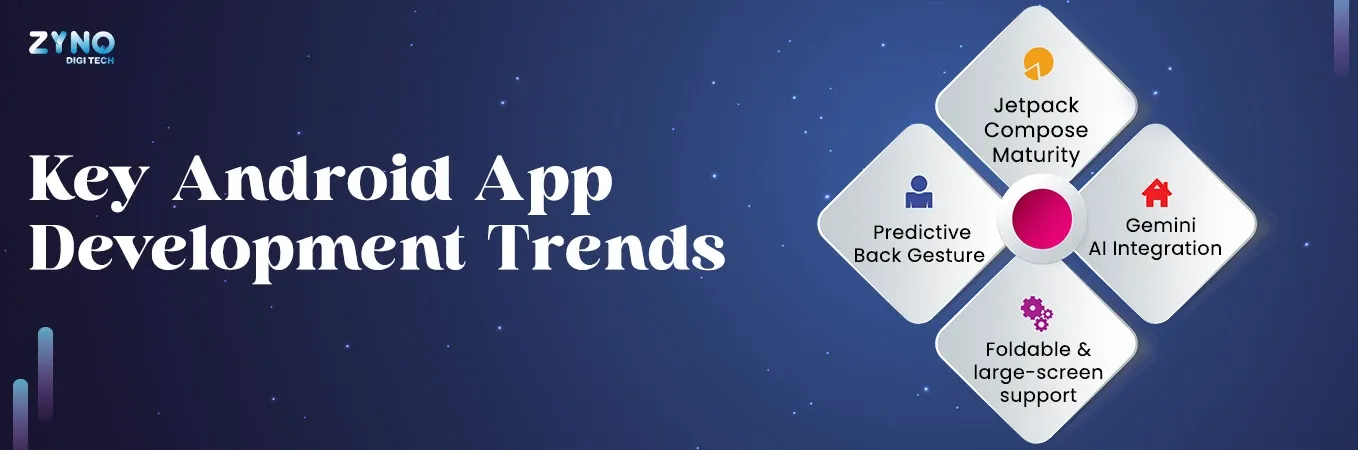
On top of that, Google Play's updated policies have raised the quality bar for app submissions. Every android app development company now needs tighter QA processes, better documentation, and cleaner privacy practices — or they risk visibility in the store.
Here's a conversation that happens a lot. A business wants a mobile app. They want it on iOS and Android. Then they find out building two separate native apps means two budgets, two timelines, and two teams to maintain them. That's when cross platform app development starts making a lot of sense.
In 2026, cross-platform isn't a compromise. For the majority of mobile products, it's genuinely the smarter approach. Frameworks like Flutter and React Native have matured to a point where the performance gap with native has nearly closed.
Why cross-platform is thriving:
That said, cross platform app development does have limits. Real-time AR, advanced camera processing, deep hardware integration — for those, native still wins. But for business apps, productivity tools, and most consumer products? Cross-platform isn't just good enough. It's often the better call.
There was a time when AR in a mobile app meant a dancing character on your table. Fun for thirty seconds, forgotten after that. That version of AR is dead. What replaced it is genuinely useful.
In 2026, AR app development and VR app development are embedded in real workflows across industries that have nothing to do with gaming or entertainment.
Where AR VR App Development Is Making the Biggest Impact
Spatial computing headsets from major manufacturers have both validated this market. Teams skilled in AR app development and VR app development are in high demand — and those who invested in this capability early are now well ahead.
Also worth noting: modern AR and VR development frameworks have made this space far more accessible. You no longer need a dedicated graphics engineering team to ship a compelling AR experience. A strong mobile development team can get you there.
Here's a truth most development teams know but don't always act on: a technically brilliant app with poor UX will fail. Not might fail. Will fail. Users aren't forgiving. They won't send feedback — they'll just delete the app and move on.
In 2026, mobile app UX design has evolved from a design discipline into a core business function. The companies that treat UX as a finishing step are losing to the ones that start there.
The data on this is pretty clear. Users who have a great first session are far more likely to return. So investing in UX isn't a creative luxury — it's a measurable business lever with a direct line to retention.
And now, with AI tools embedded inside the ux design app workflow — think automated accessibility audits, AI-generated user flow suggestions, smarter prototyping — ux design teams can iterate faster and test more ideas per sprint than ever before.
Not long ago, you had a clear choice: build a native app or build a website. Those were your two lanes. In 2026, the lane markings will fade. Web and mobile app development now overlap in ways that open up some genuinely interesting options for product teams.
Progressive Web Apps have matured to the point where, for many use cases, users can't tell the difference between a PWA and a native app. Here's why the convergence matters:
That being said, native apps still offer deeper integration with device hardware, system-level features, and platform-specific UX patterns. The smartest teams aren't choosing between web and mobile — they're choosing strategically based on their audience and their actual use case.
The tools being used to build apps have gone through a quiet revolution. Application development software in 2026 is faster, smarter, and more AI-assisted than it's ever been — and the teams using the best tools are shipping noticeably better products.
Tools that are defining modern mobile apps development:
The quality of application development software a team uses is a direct reflection of the product they can ship. Getting this right isn't just a workflow preference — it's a competitive advantage.
Users are reading permission prompts now. They're checking what data an app collects. They're deleting apps that feel invasive. That's a real shift in user behaviour — and regulators in the EU, UK, and US are catching up with legislation to match.
In 2026, privacy-first design isn't a selling point. In many markets, it's a legal requirement. Here are the mobile application trends shaping how this plays out:
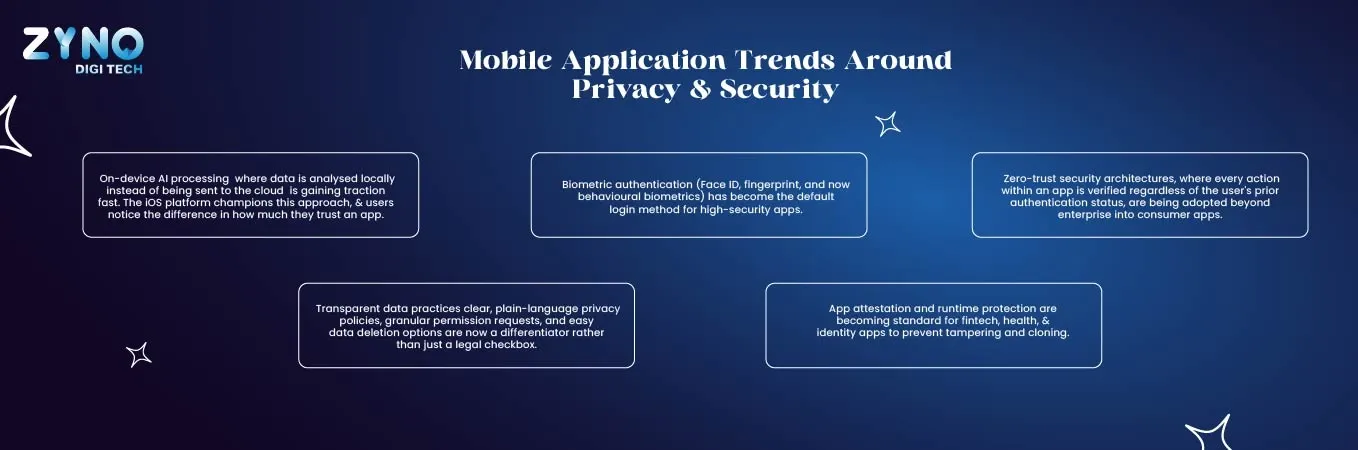
Any responsible mobile app development company building in 2026 must treat security and privacy as first-class requirements — not features to bolt on before launch. The cost of getting this wrong, both legally and reputationally, has never been higher.
Knowing all this is useful. But knowledge without execution doesn't build anything. For most businesses, the real question isn't what the trends are — it's who's going to help them act on it.
Choosing the right mobile app development company matters more now than it did a few years ago. The gap between a team that genuinely understands 2026's landscape and one that's still working from an older playbook is wide — and it shows up directly in the product.
When evaluating mobile app development services, look for:
The mobile app market rewards clarity of vision and quality of execution. A mediocre app that looks outdated or performs poorly won't get a second chance from users. But an app that genuinely works well — one that's useful, fast, and easy — becomes a growth channel in its own right.
Mobile app development in 2026 is defined by one thing: intention. Every design decision, every technology choice, every UX pattern — it all needs to be deliberate. Grounded in what the user actually needs, not what's easiest to build or fastest to ship.
The era of launching something rough and patching it later is over. Users have too many alternatives. App stores are too competitive. And honestly, the standard has just gone up across the board.
The mobile app trends covered here — AI integration, deeper iOS and Android development practices, cross platform maturity, AR VR expansion, smarter UX, the blurring of web and mobile, better tooling, and stronger privacy — aren't isolated. They connect. They all point toward the same outcome: apps that are smarter, more personal, more secure, and genuinely easier to love.
For businesses ready to build or rebuild their mobile presence, the opportunity in 2026 is real. But so is the competition. That's why working with a mobile app development company that stays ahead of these mobile app trends — and actually cares about the quality of what it ships — matters more than ever.
At ZYNO Tech by Elite Mindz, we help businesses navigate exactly this. From mobile apps development strategy and UI UX design for mobile apps to full-scale cross platform app development and ar vr app development company services — we build mobile experiences that are not just functional but genuinely compelling.
If you're planning your next mobile product and want a team that understands where the industry is headed — let's talk.
Q1. What is mobile app development and why does it matter in 2026?
Simply put — it's how apps on your phone get built. Design, code, testing, launch. All of it. But in 2026, it's not just a technical process anymore. It's a business decision. Apps are how people shop, work, see doctors, and pay bills. If your business doesn't show up well on mobile, you're invisible to a huge chunk of your audience. The stakes are higher than they've ever been.
Q2. How do I find the right mobile app development company for my project?
Honestly? Don't start with price. Start with questions. Look at what they've actually shipped — not just what's on the website. Ask how they handled a project that went sideways. A reliable mobile app development company will tell you what they can't do just as clearly as what they can. That kind of honesty is rare. When you find it, pay attention.
Q3. What's the real difference between iOS app development and Android app development?
More than most people think. iOS app development works within a tight, controlled ecosystem. Fewer devices. More consistent behaviour. Android app development is the opposite — huge device variety, different screen sizes, different hardware specs. Both need separate thinking around design, testing, and performance. Some businesses build natively for both. Others go with cross platform app development to cover both at once. Which path makes sense depends on your users and your budget.
Q4. Is cross platform app development actually worth it — or is native always better?
For most products, cross-platform is absolutely worth it. Tools like Flutter and React Native have closed the performance gap significantly. One codebase. Faster updates. Lower cost. You're not sacrificing quality — you're being smart with resources. That said, if your app needs very deep hardware access or heavy real-time processing, native might still be the right call. But for the majority of apps out there? Cross platform app development gets the job done well.
Q5. How much does UX actually affect whether an app succeeds or fails?
More than any single technical feature. Genuinely. A well-coded app with poor UX gets deleted fast. Users don't send feedback — they just leave. Good UI UX design for mobile apps is what makes the difference between someone using your app daily and someone forgetting they installed it. Every tap, every screen, every small interaction either builds trust or chips away at it. UX isn't the last step. It should be one of the first conversations.
Q6. What mobile app trends should businesses actually focus on in 2026?
Skip the hype. Here's what's real. AI built into the core of your app — not as a chatbot, but as something that makes the whole experience feel smarter. Privacy done right, because users now read permissions and regulators are watching closely. AR app development and VR app development moving into practical use cases in retail, health, and training. And UX design for apps being treated as a product decision, not a design task. These mobile app trends aren't coming. They're already here.
Q7. How much does it cost to build a mobile app in 2026?
Wide range, honestly. A basic app with core features might sit between $15,000 and $40,000. Add AI, AR features, or a complex backend and you're looking at significantly more. Cross platform app development usually costs less than building two separate native apps — same quality, smarter spend. But the real answer is: get a proper scope done first. Vague briefs lead to vague quotes. Talk to a good mobile app development services team, map out what you actually need, and then look at numbers.
Are you looking for a professional advisor for your business?
Complete the form and discuss implementation strategies with our IT expertise.
Get a Quote in Minutes
(2).webp)
The Rise of Agentic AI-Powered Mobile Apps
Read More →
2026 Mobile App Trends: AI-Powered Experiences & Smarter UX Design
Read More →
ZYNO Digital fuels smarter digital growth through data-driven marketing, creative storytelling, and performance strategies that boost visibility, engagement, and measurable business outcomes across global platforms.

ZYNO Tech delivers cutting-edge IT solutions — including web, mobile, and digital transformation services — helping businesses scale efficiently, innovate faster, and stay ahead in a connected world.

ZYNO AI harnesses the power of artificial intelligence to automate processes, enhance decision-making, and deliver predictive insights — driving innovation, agility, and measurable business growth.

ZYNO by Elite Mindz offers AI-powered products and services that unify operations, boost productivity, and drive digital transformation — helping businesses scale smarter and innovate faster.
* In just 2 mins you'll get a response
* Your idea is 100% protected by our Non-Disclosure Agreement